
The telecom industry is flooded with tech lingo that may be hard to understand if you´re not an insider. Four of the most common are MNO, MVNO, MVNE and MVNA. They describe the key roles in the mobile ecosystem.
These terms are often confused, but they represent different layers in how mobile services are delivered to customers. Understanding the difference is essential for anyone looking to launch, operate, or support a mobile operator.
In this article, we explain what each term means and highlight a few Nordic and international companies operating in these roles.
MNO – Mobile Network Operator
A Mobile Network Operator (MNO) is a telecom company that owns and operates the physical mobile network infrastructure.
This includes:
- Radio towers and antennas
- Spectrum licenses
- Core network infrastructure
- National and international roaming agreements
Because building and maintaining a mobile network requires massive investments, most countries have only a few MNOs.
Examples of MNOs
Some well-known MNOs include:
Nordic operators:
- Telenor
- Telia
- ICE (Norway)
International operators:
- Vodafone
- Deutsche Telekom
- AT&T
These companies provide the actual network connectivity that both their own customers and many virtual operators use.
MVNA – Mobile Virtual Network Aggregator
A Mobile Virtual Network Aggregator (MVNA) acts as a wholesale intermediary between network operators and multiple MVNOs.
Instead of each MVNO negotiating directly with an MNO, an MVNA purchases large volumes of network capacity from an MNO and distributes that capacity to several MVNOs
Typical services provided by MVNAs include:
- Wholesale network agreements
- SIM card management
- Network access provisioning
- Operational support
Some MVNAs, such as Billity, also provide MVNE services, offering both commercial and technical support to MVNOs.
MVNE – Mobile Virtual Network Enabler
A Mobile Virtual Network Enabler (MVNE) provides the technical infrastructure and operational platform that MVNOs rely on to run their business.
Instead of building complex telecom systems themselves, MVNOs can use an MVNE to access the technology they need.
Typical services provided by an MVNE include:
- Billing systems
- Customer management (CRM)
- Provisioning and SIM management
- Integrations with network operators
- Reporting and analytics
An example of an MVNE is Billity:
“Starting a mobile operator used to require years of development and millions in system investments,” says Jostein Engen, CEO of Billity. “Today, modern MVNE platforms make it possible to launch much faster and with far less complexity.”
MVNO – Mobile Virtual Network Operator
A Mobile Virtual Network Operator (MVNO) is a company that sells mobile services to customers without owning the underlying network.
Instead, MVNOs purchase network capacity from an MNO and build their own brand and customer offering on top of that access.
Typical responsibilities of an MVNO include:
- Branding and marketing
- Selling mobile subscriptions
- Customer service
- Pricing and product development
- Managing the customer relationship
Examples of MVNOs
Some well-known MVNOs include:
Nordic examples:
- Trønder Mobil (Norway)
- Chilimobil (Norway)
International examples:
- Lyca Mobile – one of the world’s largest MVNOs
- Tesco Mobile (UK) – a successful retail MVNO partnership
Many MVNOs focus on specific customer segments, such as price-sensitive consumers, digital-first users, or niche communities.
Starting a mobile operator doesn´t need to be complicated
In many markets, the telecom value chain looks like this:
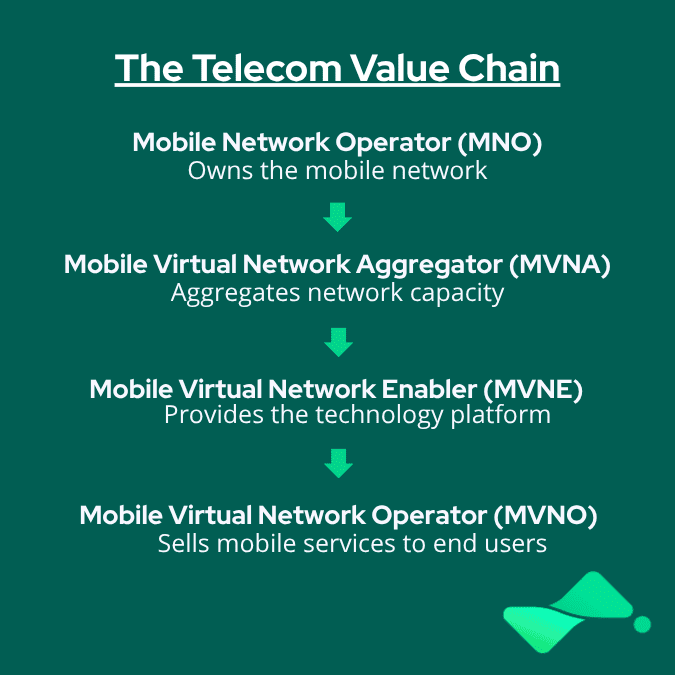
In reality, these roles often overlap. Some companies combine multiple functions depending on the market and business model.
“The telecom industry is modular,” says Jostein Engen. “New operators no longer need to build everything themselves. Instead, they can combine specialized partners that handle the network, technology and operations. Basically, you don`t need to be a telecom industry expert to start a mobile operator anymore.”